
KNOWLEDGE BANK
| Published October 16, 2026
Social Media Affects Your Visibility in AI Search
– Here’s How to Make Your Business More Visible
Social media is no longer just about reaching followers, building relationships, and driving engagement. A new study shows that content from social media platforms also appears in AI-generated search results. This means that companies that want to be visible on Google, in ChatGPT, and in other AI services need to start viewing social media as part of their overall SEO strategy.
When someone searches for a product, service, or company, Google is no longer the only way to find information. More and more people are using AI services to get answers, compare options, and find recommendations.
But where does AI get the information that forms the basis for its answers?
New Study: Social Media Appears in AI-Generated Search Results
SE Ranking has analyzed 100,000 keywords across various industries to investigate which sources appear in traditional search results and AI-generated answers.
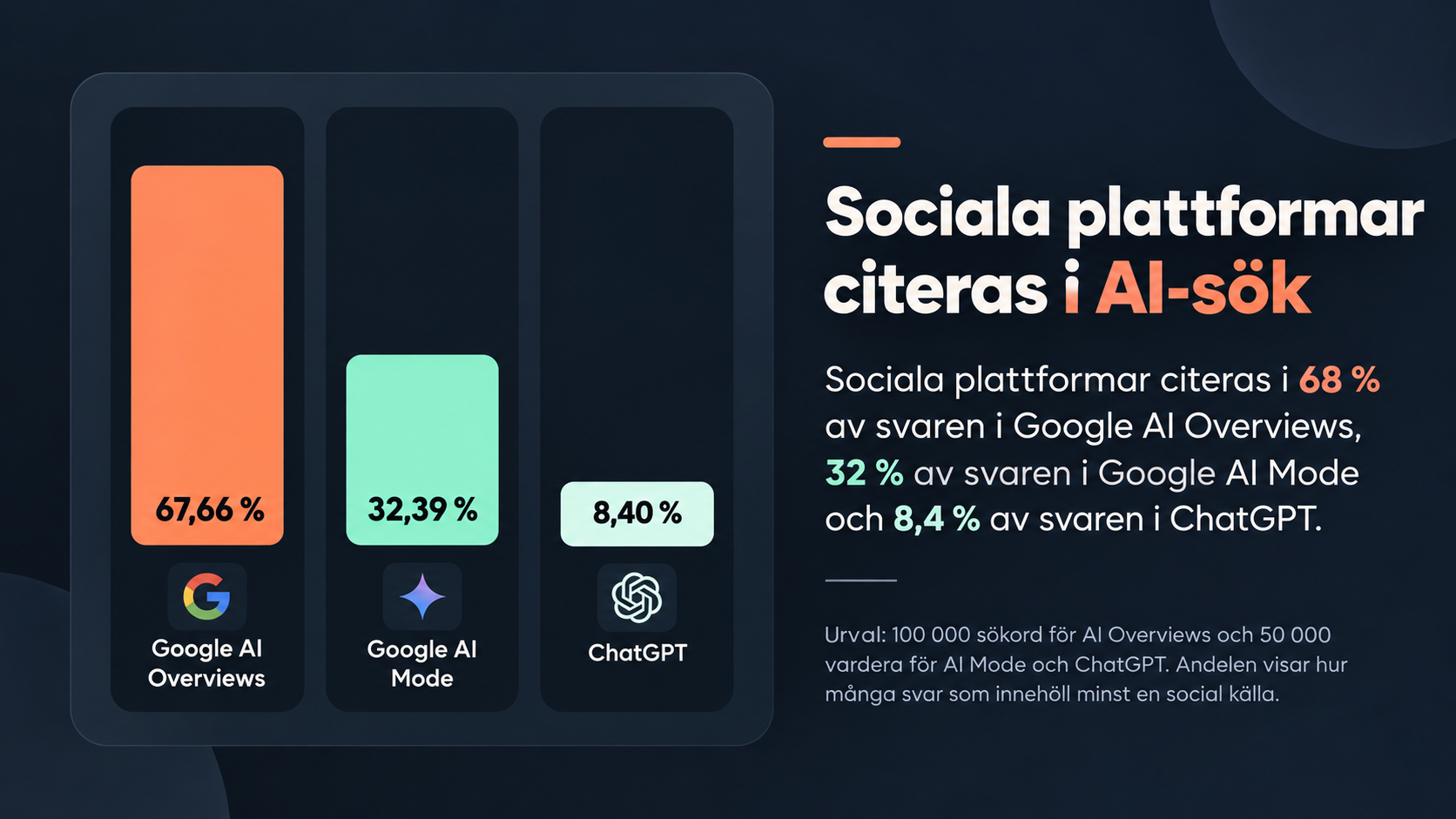
The results, which were presented by Social Media Today in October 2026, show that links from social media platforms appeared in:
- 67.66% of the responses in Google AI Overviews
- 32.39% of the responses in Google AI Mode
- 8.4% of the responses in ChatGPT
The figures show that social media is already being used as a source of information in AI searches, but also that there are significant differences between various AI services.
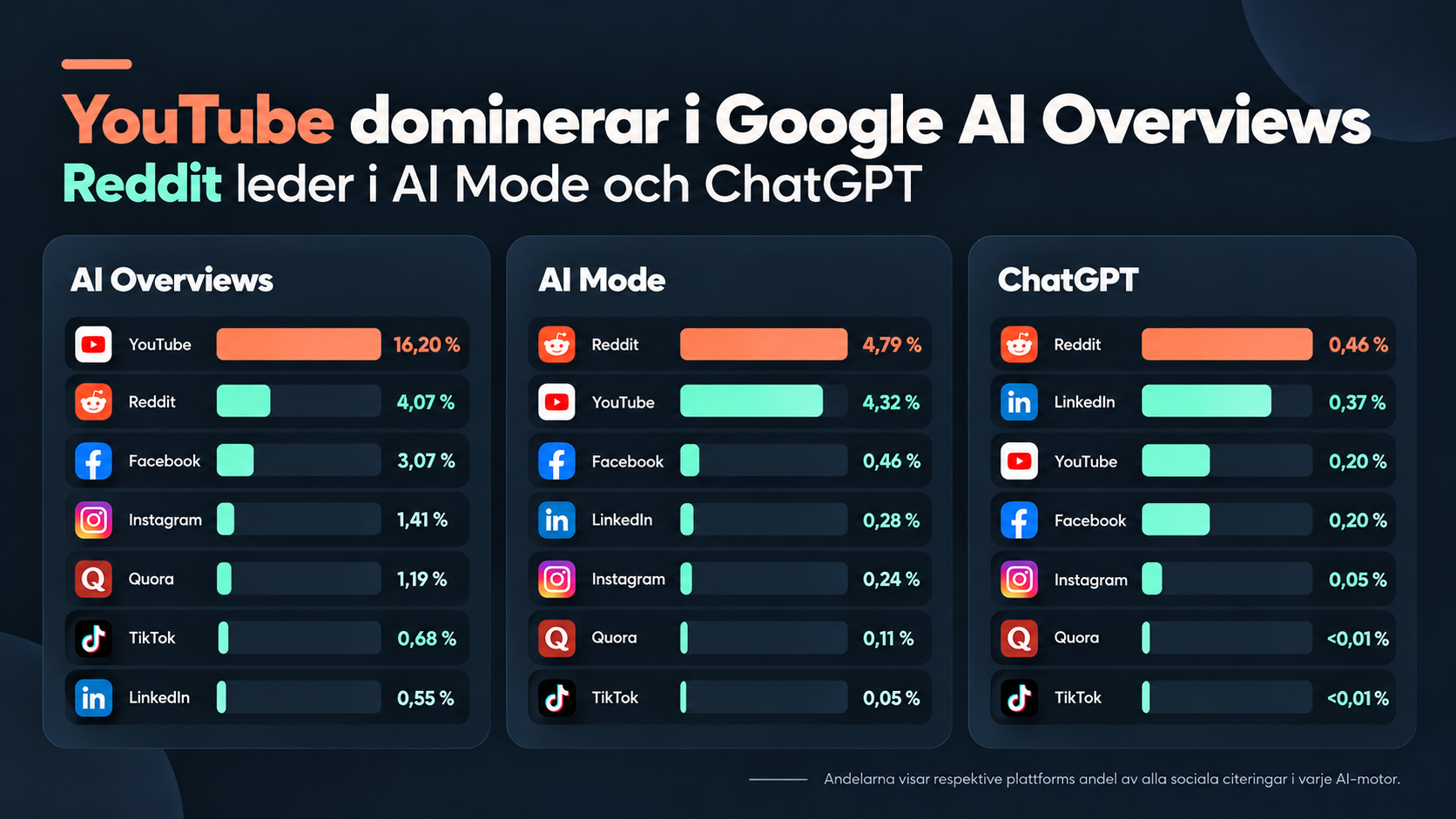
YouTube was the most frequently cited social platform in Google AI Overviews, while Reddit and LinkedIn were among the top social platforms in ChatGPT.
At the same time, it is important to understand what the results actually mean. The study shows how often social media platforms are cited as sources; it does not mean that a certain number of posts or followers automatically leads to greater visibility.
The key takeaway is that companies should no longer view their websites and social media as two completely separate parts of their marketing efforts.
Source: Social Media Today – AI favors brands with an active social media presence, October 7, 2026.
Why is social media important for AI search?
In order to provide users with relevant answers, AI-based search services need to find and interpret information from various sources.
This could include the company's own website, but also, for example, industry articles, customer reviews, videos, discussions, and social media content.
If a company regularly shares relevant information about its products, services, and areas of expertise, it can help create a clearer online brand image.
Imagine, for example, that someone asks an AI service:
“Which companies can help us with digital marketing and SEO?”
The AI service can then use available information from several different types of
A company that publishes relevant guides on its website, shares knowledge on LinkedIn, and produces informative videos on YouTube has more opportunities to be discovered through various sources of information.
A strong brand is becoming increasingly important
In the past, SEO has primarily been about optimizing websites for relevant keywords and improving rankings in Google's search results.
It is still an important part of the work.
But as more and more people get their answers directly from AI, companies also need to consider how their brand is perceived and described elsewhere on the internet.
Being mentioned in relevant contexts, contributing expert knowledge, and maintaining a presence on the platforms where the target audience seeks information can strengthen the company’s digital presence.
That is why the interplay between SEO, social media, PR, and content marketing is becoming increasingly important.
SEO, AEO, and GEO—what's the difference?
As AI changes search behavior, terms such as AEO and GEO have become increasingly common.
But what do they actually mean?
SEO – Search Engine Optimization
SEO stands for search engine optimization and involves making a website more visible in organic search results, especially on Google.
This is achieved, among other things, by focusing on relevant content, keywords, technical optimization, and the website's authority.
The goal is for potential customers to find the company when they search for relevant products, services, or information.
AEO – Answer Engine Optimization
AEO is about structuring content so that it clearly answers users' questions.
By writing specific answers, using relevant subheadings, and explaining topics in a simple way, the content becomes easier to understand and use in various search engines.
GEO – Generative Engine Optimization
GEO is about improving a company's chances of being seen, mentioned, or cited as a source in AI-generated responses.
For example, this could involve creating credible content, demonstrating clear expertise, generating digital mentions, and providing relevant information across multiple platforms.
Simply put, SEO helps people find your website, AEO makes it easier to get answers from your content, and GEO focuses on visibility in AI-generated search results.
These three areas overlap and work best as parts of a unified strategy.
Here's How to Use Social Media to Boost Your SEO and AI Visibility
Publishing more content does not automatically lead to better results.
The key is to create content that helps the target audience and clearly demonstrates the company's expertise.
Here are five practical ways to get to work.
1. Create content that answers customers' questions
Start by identifying the questions your potential customers are actually asking.
What are they searching for on Google? What questions does the sales department get? What problems do customers need help with?
Use these questions as a starting point for content on both the website and social media.
For example, a company that specializes in digital marketing might respond:
- How can you make your business visible on ChatGPT?
- How do Google AI Overviews work?
- What is the difference between SEO and GEO?
- How does social media affect SEO?
- How much does search engine optimization cost?
By publishing clear and useful answers, you create content that is relevant to both people and search engines.
2. Choose the right social media platforms for your target audience
Not all social media platforms work the same way. A study by SE Rankings shows that different AI services use social media sources to varying degrees.
For example, YouTube is frequently mentioned in Google AI Overviews, while Reddit and LinkedIn are other relevant platforms in the context of AI.
However, that does not mean that all companies have to be present everywhere.
For a B2B company, LinkedIn can be a natural channel for sharing expert knowledge and building relationships. For a company that sells products that need to be demonstrated, YouTube may be more relevant.
The most important thing is to choose channels based on the target audience’s needs and the company’s ability to create valuable content.
3. Reuse content across the website and social media
One of the most effective methods is to have the website and social media channels complement each other.
You don't need to create entirely new content for each channel.
For example, a longer blog post could be:
- A LinkedIn post highlighting the key insights
- A short video in which an expert explains the topic
- Several short posts that answer common questions
- A newsletter with a link to the complete guide
This way, a single topic reaches a wider audience.
The website can also serve as the central hub for more in-depth information.
This makes it easier to create a cohesive content strategy in which different channels contribute to the same business goals.
4. Showcase the company's expertise and credibility
It's not enough just to be visible. The content also needs to be credible and useful.
So please feel free to share content based on real-life experience and knowledge.
These can include customer case studies, your own analyses, guides, practical tips, or examples of how you solve common problems in your industry.
Avoid posting only general sales messages.
Instead, show what the company is actually capable of and the benefits that this expertise brings.
This helps your target audience understand why they should choose you, while also contributing to a clearer digital brand profile.
5. Make sure the website is technically optimized
Although social media is becoming more important for AI visibility, a well-functioning website remains the foundation of a sustainable SEO strategy.
Search engines need to be able to find, read, and understand a website's content.
Therefore, you should, among other things, ensure that:
- Important pages can be crawled and indexed.
- The content has clear H1, H2, and H3 headings.
- The website works well on mobile devices.
- The pages load quickly.
- Relevant pages link to one another.
- The company's services and areas of expertise are clearly described.
A solid technical foundation makes it easier for search engines to understand the content and helps users navigate the website.
How do you measure a company's visibility in AI searches?
Measuring AI visibility doesn't quite work the same way as traditional SEO.
Common SEO tools often focus on Google rankings, organic traffic, and conversions.
When working with AI search, it may also be helpful to follow up on:
- How often the company is mentioned in AI-generated responses.
- If the company's website is used as a source.
- Which competitors are recommended for relevant questions.
- How much traffic comes from AI-based search engines.
- Whether AI-related traffic leads to inquiries or other conversions.
It is important to analyze the results over time because AI-generated responses can vary across different searches and platforms.
Individual searches therefore rarely provide an accurate picture of overall visibility.
Do you want your business to be more visible on Google and in AI searches?
You don't need to start putting an “AI-generated” label on everything you produce.
A better first step is to gain control over how AI is used within the organization.
Identify which tools you use and for what purposes. These might include, for example, generative AI for text and images, AI features in advertising platforms, chatbots, or video editing tools.
Next, review situations in which transparency may be particularly important.
For example, ask:
- Do we use AI to create lifelike people, voices, or events?
- Do we automatically publish AI-generated content without human review?
- Do customers understand when they communicate with our AI chatbot?
- Do we know who is responsible for content generated by AI?
- If you can answer those questions, you're already well on your way.
If you can answer those questions, you're already well on your way.
The AI Act is about more than just a label
At Frankly Media, we help companies boost their digital visibility through search engine optimization, content strategy, and AI SEO.
We combine technical expertise, relevant content, and data-driven analysis to create the conditions for increased visibility, high-quality traffic, and more business opportunities.
Would you like to know how your business can become more visible on Google, ChatGPT, and other AI-based search engines?
Learn more about AI SEO at Frankly Media or contact us and we’ll help you take the next step.
Would you like to learn more about digital marketing and how the search landscape is evolving? Explore more articles in our knowledge base or contact us if you’d like to discuss how new channels and changing search behaviors can impact your marketing.
Would you like to know how we use AI, data, and human review in our own work? Learn more about our AI principles.